
In short. The reasoning framework behind reconstructive plastic surgery: from simple closure to skin grafts, local flaps, and microsurgical free tissue transfer, and why the simplest safe option usually wins.
Key points
- A skin graft is fast and reliable but needs a healthy, bleeding bed to survive and leaves a patch-like contour and colour mismatch.
- A local flap moves neighbouring skin with its own blood supply, giving better colour and texture match at the cost of extra scars.
- A free flap can rebuild almost anything — jaw, breast, lower leg — but takes many hours, needs intensive monitoring, and carries a small but real risk of total flap loss.
When skin and deeper tissue are lost — to trauma, tumour removal, burns, or infection — the question is never simply how to close the hole. It is which of several very different techniques will restore cover, contour, and function with the least risk and the fewest operations. Surgeons think about this choice using a framework called the reconstructive ladder, and understanding it helps patients make sense of the plan they are offered.
The problem being solved
A wound is not just an area of missing skin. What matters is its depth, its location, what structures lie exposed underneath (bone, tendon, cartilage, vessels), whether the wound bed can support a graft, and how much tension a closure would create. A shallow wound on the cheek and an open fracture on the shin are both “holes,” but they live at opposite ends of the ladder.
Who needs which rung
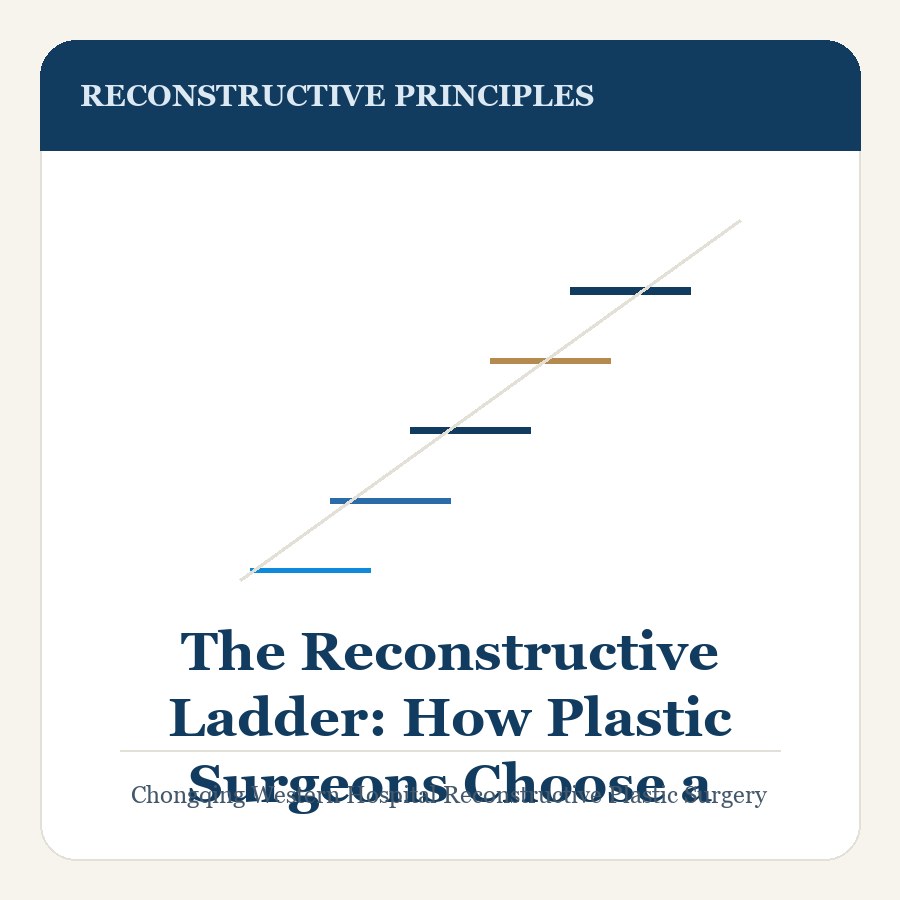
The ladder runs from simple to complex: healing by natural contraction, direct sutured closure, skin grafting, local and regional flaps, and finally microsurgical free tissue transfer, where a block of skin, fat, muscle, or bone is moved with its blood vessels and reconnected under the microscope. Good reconstructive judgement means climbing only as high as the wound demands — not as high as the surgeon technically can.
The options compared
Simpler is usually safer
A skin graft is fast and reliable but needs a healthy, bleeding bed to survive and leaves a patch-like contour and colour mismatch. A local flap moves neighbouring skin with its own blood supply, giving better colour and texture match at the cost of extra scars. A free flap can rebuild almost anything — jaw, breast, lower leg — but takes many hours, needs intensive monitoring, and carries a small but real risk of total flap loss. The plan weighs defect, patient, and risk together.
Anaesthesia and staging
Small closures and grafts may be done under local anaesthesia; flaps and free tissue transfer require general anaesthesia in a full operating theatre. Reconstruction is often staged: a first operation to control the wound, a second to rebuild, and sometimes later refinements. Staging is planning, not failure.
What reconstruction can and cannot achieve
It can close wounds that would never heal alone, cover exposed vital structures, restore contour, and protect function. It cannot make tissue identical to what was lost: grafts differ in colour and texture, flaps carry their own scars, and sensation in transferred tissue is always reduced. Honest planning states these trade-offs before the first incision.
Recovery and follow-up
Simple closures heal in one to two weeks; grafts take about a week to take and months to soften; free flaps require several days of close monitoring in hospital. All scars mature over twelve to eighteen months, and long-term review watches for contracture, recurrence of the original disease, and late functional problems.
Seek review promptly if
- A graft or flap turns dusky, purple, or black, or becomes cold and swollen — blood supply problems are time-critical.
- Fever, spreading redness, increasing pain, or discharge develops around any reconstruction.
- A wound that was healing opens up, or a healed area breaks down again without injury.
Frequently asked questions
How is the right reconstructive technique chosen for a wound?
By reading the wound, not by preference. Its depth, the structures exposed beneath it, whether the bed can support a graft, and how much tension a closure would create all point to a rung on the ladder, and the simplest safe option is chosen.
Does the ladder mean the most complex operation is the best one?
No. The ladder is climbed only as far as the wound demands. A graft is faster and safer than a flap where it will take, and a flap is safer than free tissue transfer where it will cover the defect. Technical capability is not the deciding factor.
Why might reconstruction be planned over several operations?
Reconstruction is often staged deliberately. A first operation may control the wound or confirm that disease is clear, a second rebuilds, and later refinements adjust contour or function. Staging spreads risk and lets each step be judged on healed tissue rather than assumed in advance.
Risks & Limitations
- Reconstruction is usually staged — more than one operation is normal, and the plan may change as healing progresses.
- Donor-site scarring and discomfort, including after rib cartilage harvest.
- Partial or complete failure of a flap or graft, which may require further surgery.
- Scars are permanent. They mature and fade but never disappear.
- Asymmetry and the inherent limits of matching a normal side.
- Altered sensation, numbness or weakness in the operated area.
- Contracture, which may need release procedures later.
- Final assessment is made at 6–12 months, and longer in growing children.
When to Seek Care
- A flap or graft that turns dark, cold, black or stops bleeding when pricked.
- Fever above 38 °C, or spreading redness, warmth or discharge around a wound.
- New or worsening pain, swelling or fluid leakage from the operative site.
- Bleeding that does not stop with gentle pressure.
- Any change in a reconstructed area that concerns you, however minor.
References & Further Reading
- American Society of Plastic Surgeons (ASPS) — reconstructive surgery guidance
- World Health Organization (WHO) — burn and trauma care resources
- Chinese Medical Association, Plastic Surgery Branch — clinical guidance
- Cochrane Library — systematic reviews in wound and reconstructive care
This page is patient education, not medical advice, and it does not cite individual studies. Discuss your own case with a qualified clinician. To arrange an assessment at Chongqing West District Hospital, see Contact & Consultation.